
By Andrew Gumbel for The Guardian• March 31, 2026
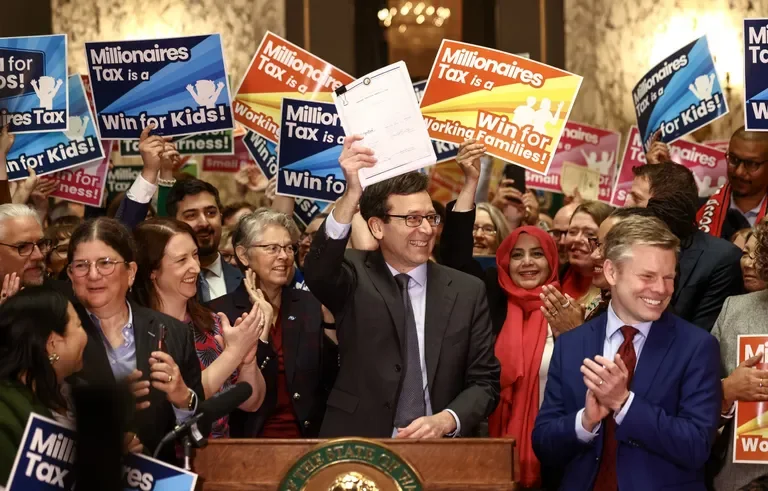
As living costs rise, the state where Gates and Bezos made billions is targeting top earners – could other states follow?
Noel Frame knows exactly how difficult it is to raise taxes on the ultra-wealthy, because she has been trying to do just that – first as an activist, then as a state legislator – for the past 15 years. And until recently almost all of her efforts ended in failure.
She lives in Washington, a solid blue state that should, in theory, be hospitable to the idea of more progressive taxation and has plenty of multimillionaires to target, since it is the home of Microsoft, Amazon and an array of other tech-driven corporations. While the wealth of these tech giants has grown exponentially in recent decades, the state – which levies no income taxes – has struggled to bring in enough revenue to pay for basic services like public schooling and long-term healthcare.
For each of the past five years, Frame has proposed a wealth tax that would treat the investment income of the state’s most affluent residents as another form of property, subject to the same 1% tax rate that middle-class homeowners pay on their houses. The closest she came was at the end of 2024, when the state’s outgoing governor, Jay Inslee, championed the idea, saying the state needed not to “go backwards” any more.
However, the president of Microsoft, Brad Smith, made it his mission to stop the initiative dead in its tracks. “What are you doing to us?” he reported asking the governor in a phone call. In a matter of weeks, Smith raised millions of dollars from the business community to lobby against the tax, arguing that it would kill competitiveness and cause companies and wealthy individuals to leave the state.
The proposal became so toxic that Inslee’s successor as governor, fellow Democrat Bob Ferguson, wanted nothing to do with it. Instead, he instituted painful cuts, and, for a time, pressed for furloughs of state workers which so infuriated the head of the state’s largest public-sector union that he called Ferguson a “ratfink” and vowed to work against him serving more than one term.“The tech companies – man oh man, do they have far too much influence on our political culture,” Frame reflected. “They think they are the only industry in town, and sadly some people seem to believe that.”
A year, though, has proved to be a long time in Washington and national politics. With the state facing a multibillion-dollar spending gap and even affluent public school districts going into receivership for lack of adequate funding, the state legislature has just passed a different form of tax aimed at the state’s ultra-wealthy – a 9.9% income tax that kicks in at a million-dollar threshold – and Ferguson signed it on Monday.
Amy Hanauer, executive director of the DC-based Institute on Taxation and Economic Policy, which tracks state trends, said she was not surprised to see Washington act first because it has one of the most regressive tax systems in the country. “This was very overdue, and people in Washington are really excited to see it,” she said. “The bottom line is that billionaires are walking away with a larger share of our economy every single year, and working people can’t afford the basics any more. This movement was growing, this moment was coming.”
Passing the millionaire tax in Washington, which will not come into effect before the 2028 tax year, is unlikely to go uncontested. Frame and the measure’s other champions expect a legal challenge based on a 93-year-old state supreme court ruling that deems any form of income tax to be unconstitutional. They are cautiously optimistic that the current supreme court will overturn that ruling. They also expect opponents of the bill to put an initiative on the ballot inviting voters to strike the measure down.
That is what happened in 2010, when the state last tried to introduce an income tax and voters rejected it. It is also what happened in 2024, when a hedge-fund billionaire named Brian Heywood, working hand in glove with the state Republican party, sought to overturn a state capital gains tax introduced three years earlier – only that time the voters upheld the tax, by a resounding margin.The about-face in public attitudes over a 14-year period was, Frame said, a result of growing awareness that Washington’s tax system – reliant almost entirely on sales, business and property taxes – demanded far more of the state’s poorest residents than it did of its richest.
According to the Economic Opportunity Institute, a Seattle-based non-profit, the bottom 20% of state households pay 13.8% of their income in state and local taxes, the middle 20% pay 10.9%, and the wealthiest 1% pay just 4.1%.
That awareness has, in turn, made it easier to push back against well-worn arguments that any new tax would, sooner or later, affect middle- and lower-income households and that any attempt to demand more from wealthy companies and individuals would cause them to flee the state for somewhere cheaper, resulting in lost jobs and a weaker economy.
Research based on census data and Internal Revenue Service records does not tend to bear these arguments out. Rather, it shows that the primary reasons for affluent people to move from one state to another are work opportunities, family and lifestyle choices, with taxation a distant consideration in most cases if it comes up at all. The same holds for companies whose success is often rooted in their geographical location and in the staff they have hired and come to depend on. “Millionaire tax flight is occurring,” a 2016 study published in the American Sociological Review found, “but only at the margins of statistical and socio-economic significance.” A 2023 study by the Center on Budget and Policy Priorities came to very similar conclusions.
Andrew Gumbel has worked as a foreign correspondent in Europe, the Middle East and the US and is the author of several books, including Oklahoma City: What The Investigation Missed – And Why It Still Matters, and his latest, Down for the Count: Dirty Elections and the Rotten History of Democracy in America
